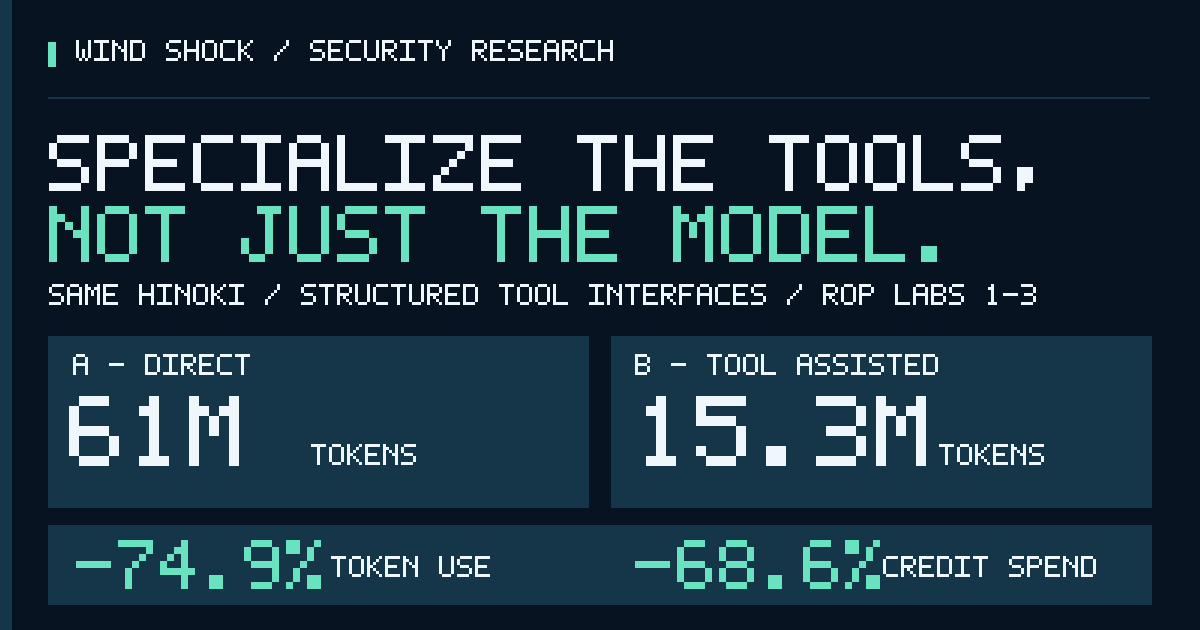
The same Hinoki model tackled three synthetic Linux ROP labs using two different development architectures. The distinction is the boundary between model-authored exploit logic and specialized library functions, connected through explicit Python interfaces.
Same Hinoki modelLab 1 / 2 / 3 · Linux x86_64ASLR enabled · marker / shell verified
OBSERVED TOKEN REDUCTION−74.9%61M → 15.3M tokens
OBSERVED CREDIT REDUCTION−68.6%$7.04 → $2.21
SYNTHETIC LABS VALIDATED3 LabsMarker and shell checks · ASLR ON
01
A vs B — the development architecture
A · Direct implementation
MODEL-AUTHORED
61M tokens $7.04
Hinoki · LLM
Analysis, reasoning, exploit logic and iterative code authoring.
↓
1 · Binary & ABI analysis
Interpret gadgets, register constraints, calling conventions and stack layout.
Target-specific CSU indirect-call frame; not full automatic ROP synthesis.
pwntools.ELF
Symbols, GOT, libc address context
StagedRopSession
Leak read, libc rebase, Stage 2 delivery
Harness · build_stage2()
Explicit Stage 2 construction and protocol decisions
Docker · pytest
Lab 1–3 marker / shell verification
Technical boundary: the harness still explicitly selects gadgets, arguments and call order. No general goal-to-multistage-exploit planner is claimed.
Same Hinoki model. Specialized tools and explicit interfaces. 74.9% fewer observed tokens.
Hinoki dashboard aggregates over Lab 1–3, not per-request traces. B includes existing-path verification and an implementation/integration session.
02
B: Real function call graph & ownership
The path below is derived from the published Lab harness. Select any function group to see its actual responsibilities and upstream calls. Solid arrows represent the executable path; the dashed branch marks optional JSON-safe summary APIs.
↓
Two actual, Lab-specific analysis / chain-building paths
Observed end-to-end Hinoki usage in three synthetic labs: direct exploit authoring versus an implementation that delegates selected functions to specialized tools. It does not claim an identical savings ratio for every request.
Exact JSON summary adapters exist, but should not be confused with model tool calls proven in the A/B sessions. Current ROP chain inputs remain explicitly chosen by the harness.