The same defect keeps showing up across services:
- per-user purchase-limit bypass
- one draw/opportunity consumed by several concurrent requests
- duplicate coupon-cancellation processing
- daily entry-ticket issuance over the limit
- daily point-reward count exceeded
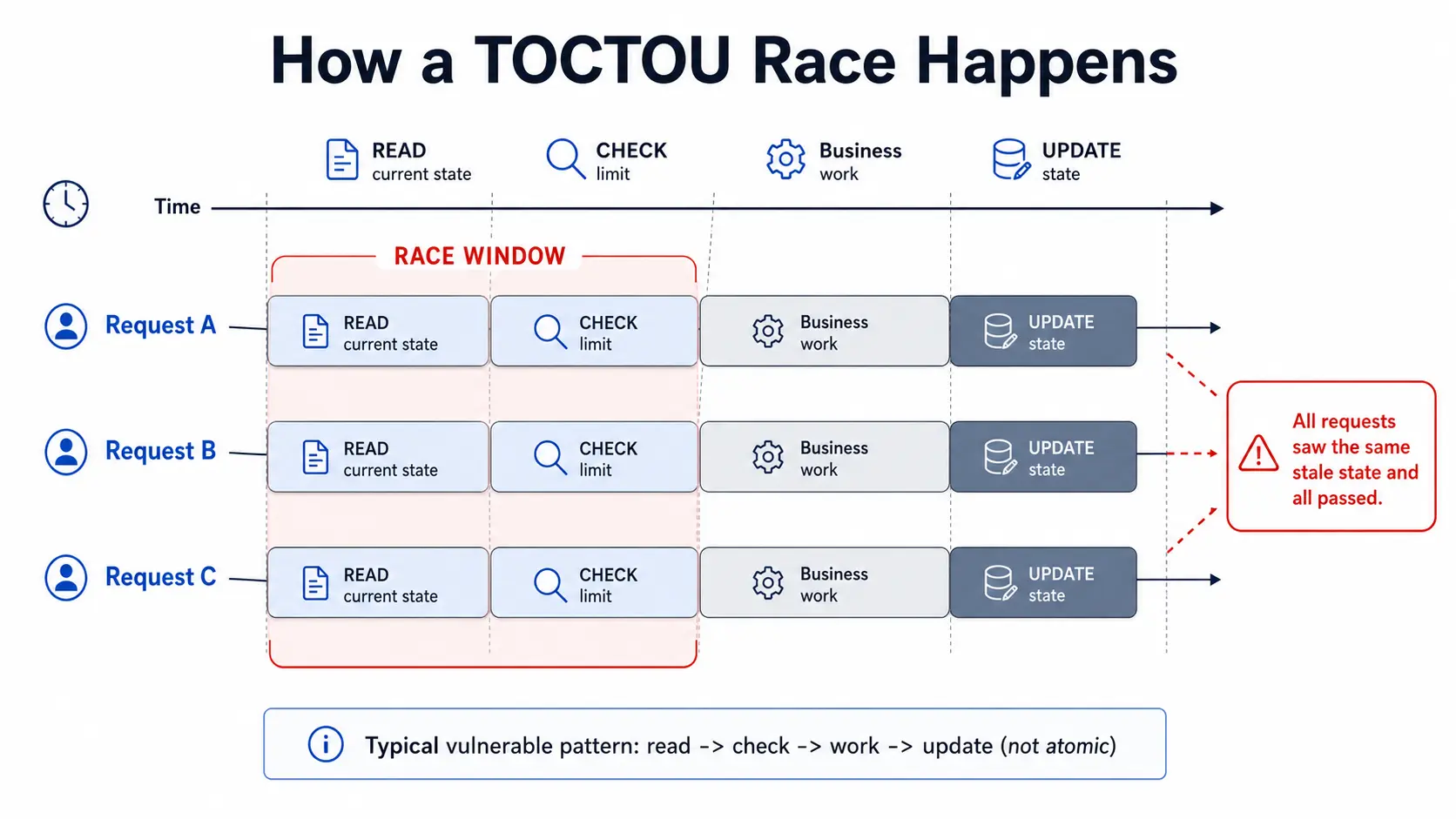
They all share one shape. “Read current state → CHECK the limit → do the business work → UPDATE the state” is not one atomic operation, so when several requests for the same user arrive together, they all read the same stale state and all pass the check.
int count = repository.getTodayCount(memberId);
if (count < limit) {              // A, B, C all read count = 4, limit = 5
    rewardService.givePoint(memberId);
    repository.insertHistory(memberId);   // → 3 rewards granted for a 5-limit... but 7 total
}
The tempting security ask is “just put a Redis distributed lock on everything.” But that pushes real cost onto every team — Redis dependency, lock timeouts, ownership, fail-open/fail-close policy, multi-instance concerns, code complexity. So instead of mandating an implementation, the requirement should be:
Guarantee atomicity so that counts / opportunities / points are not exceeded even under concurrent requests — and prefer the DB’s own atomic operations first.
I turned that into a runnable lab and measured which mitigations actually hold on a realistic topology (nginx + Tomcat×2 + a shared Postgres + Redis, two WAS instances behind a round-robin). Everything below is backed by that lab.
Repository (code + reproducible lab): https://github.com/windshock/race-condition-lab
Here is the whole thing in one picture, then the details.
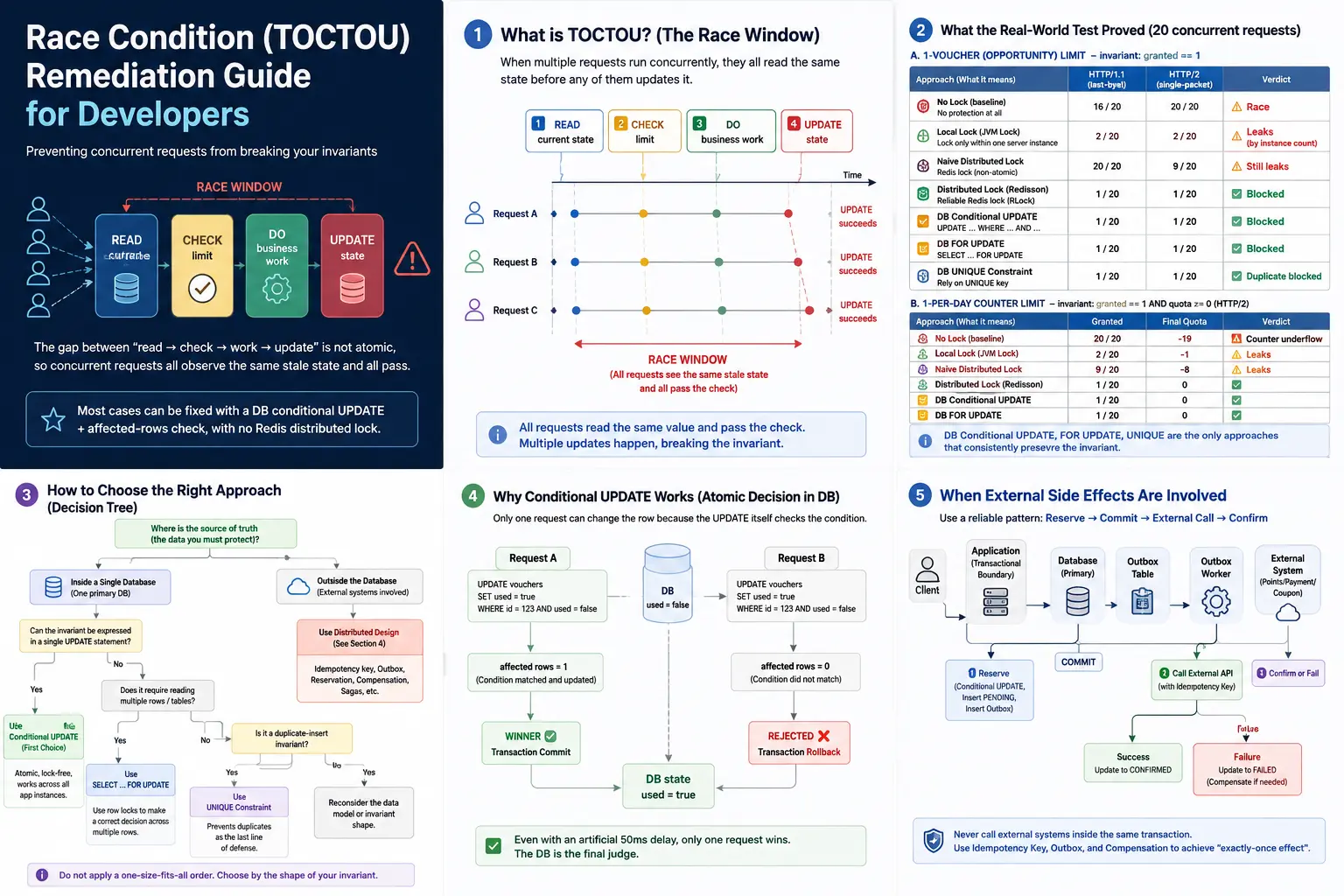
The full guide at a glance: what TOCTOU is, what the real-stack test proved, how to choose an approach, why conditional UPDATE works, and how to handle external side effects.
Reproduce it yourself
Everything below is measured; you can rerun it end-to-end:
git clone https://github.com/windshock/race-condition-lab
cd race-condition-lab/realstack
./run_all.sh 20   # boots the stack + two scenarios × all modes A/B + PASS/FAIL (exit 1 if a mitigation leaks)
- Full guide (English / Korean) and all code: https://github.com/windshock/race-condition-lab
- Vulnerable core and mitigation modes:
realstack/app/src/main/java/com/example/claim/ClaimTxService.java - Mode routing and out-of-transaction exception conversion:
.../ClaimService.java
The lab intentionally keeps the vulnerable and naive-lock modes as negative controls, so you can watch a real stack leak and then watch the DB-native fixes hold — with no Redis lock required.
Key terms (glossary)
A quick reference for the jargon used below.
- TOCTOU (Time-of-Check to Time-of-Use) — a defect where the moment you check a value and the moment you use it are separated, so the state can change in between.
- Race window — the short interval between check and change; if another request slips in here, a race occurs.
- Atomicity — bundling several steps so they all happen or none happen, with no intermediate state visible from outside.
- Invariant — a rule that must always hold under any concurrency (e.g. “granted once”, “the counter can never go negative”).
- CAS (Compare-And-Set) — “change to Y only if the value is still X,” done as one atomic operation. In a
database, a conditional UPDATE (
... WHERE used = false) is a CAS. - Affected rows — how many rows an UPDATE actually changed. In a conditional UPDATE,
1means you won,0means someone else already did it. - UPSERT /
ON CONFLICT— insert if absent, otherwise ignore/update, as one atomic statement; used to prevent duplicate inserts. SELECT … FOR UPDATE— read a row while taking a write lock on it (pessimistic locking), so other transactions touching that row must wait.- Idempotency key — an identifier that makes repeated requests with the same key take effect only once, so retries don’t double-spend.
- Outbox pattern — store the DB change and the “message to send” in the same transaction; a separate worker delivers it later, avoiding the commit-vs-publish mismatch (dual-write).
- Saga / compensating transaction — split one large operation into steps; if a later step fails, undo the earlier ones with compensating actions to restore consistency. Used when the work spans services/DBs that can’t share a single transaction.
- Redlock — a Redis-based distributed-lock algorithm; safe only if acquisition and release are handled atomically.
- READ COMMITTED — the default isolation level that reads only committed data; even here, an UPDATE re-reads the latest committed row at execution time and re-evaluates its WHERE.
- Concurrency guard — a supplementary control that caps how many requests run at once (e.g. “same user + same object → one at a time”).
0. What the lab proves vs. what is only a recommendation
Be honest about the boundary — over-reading the results leads to false confidence.
| Category | Content |
|---|---|
| Proven by the lab | Limits inside a single DB (1 voucher / 1 daily counter) let exactly one of 20 concurrent requests through when using conditional UPDATE, FOR UPDATE, or UNIQUE. A JVM-local lock leaks by the number of instances. A non-atomic Redis lock still leaks. |
| Recommendation only (outside the lab) | Integrity when the side effect lives outside the DB — external point grants, payments, coupon cancellation. This cannot be proven with a single transaction; it needs architecture — reservation, idempotency keys, outbox, compensating transactions (section 6). |
“Conditional UPDATE stops the race” is a proof about DB-internal state. “The points are granted exactly once” is a distributed-systems design problem. Do not conflate the two.
1. How a TOCTOU race actually happens
When multiple requests run concurrently, they all read the same state before any of them updates it. The window between READ/CHECK and UPDATE is the race window (the cover image above shows exactly this: three requests all see the same stale state and all pass).
The typical vulnerable pattern is read → check → work → update, none of it atomic. And it does not
require a flood — two or three concurrent requests are enough. (An HTTP Transfer-Encoding: chunked or
HTTP/2 single-packet trick can align request
completions into a tiny window and make the race far more reproducible, but chunked is a legitimate
feature; blocking it is not the real fix.)
Aside: chunked isn’t only an attacker’s trick — frameworks emit it by default
It’s easy to see chunked as an “attack technique,” but it’s actually normal traffic that modern frameworks
emit by default. Spring Framework 6.1 changed most ClientHttpRequestFactory implementations behind
RestClient/RestTemplate to stop buffering the whole request body, in order to reduce memory usage
(issue #30557). The old flow was:
Java object → build the whole body in a ByteArrayOutputStream → byte[] → HTTP client → socket
Holding the entire body in memory is what let it compute a length and set Content-Length. Since 6.1 it
serializes straight to the network stream, so content whose size isn’t known up front (like JSON) goes out
without Content-Length, as chunked
(6.1 release notes).
So the trade-off isn’t “we gave up computing the length” — it’s “we gave up materializing the entire body
in memory just to learn its length.” For a single 340-byte request the memory saving is meaningless, but
the same API must handle everything from 340 B to 300 MB, so the framework chose streaming-first rather than
special-casing tiny requests. The lost Content-Length and the chunked framing are side effects of that
choice.
Two things matter here:
- This is Spring’s client (outbound) behavior. So it does not mean “Spring apps become race-vulnerable
automatically.” It means
chunkedis normal traffic that appears without any developer intending it — so an nginx / WAF / IDS that treatschunkedas anomalous, or assumesContent-Length, will misfire. Again: blockingchunkedis not the real fix. - A framework’s ordinary
chunkedstreaming is not the attacker’s last-byte / single-packet synchronization: the attacker deliberately withholds the final byte/frame to shrink the race window. What the two really share is elsewhere — a low-level implementation choice nobody consciously made produces wire-level behavior — which is exactly this article’s theme: the TOCTOU window that appears while no developer is looking.
2. What the real-stack test proved (20 concurrent requests)
Two scenarios, run A/B across every mode, counted from the DB (grant_log / quota), on two WAS instances
sharing one Postgres.
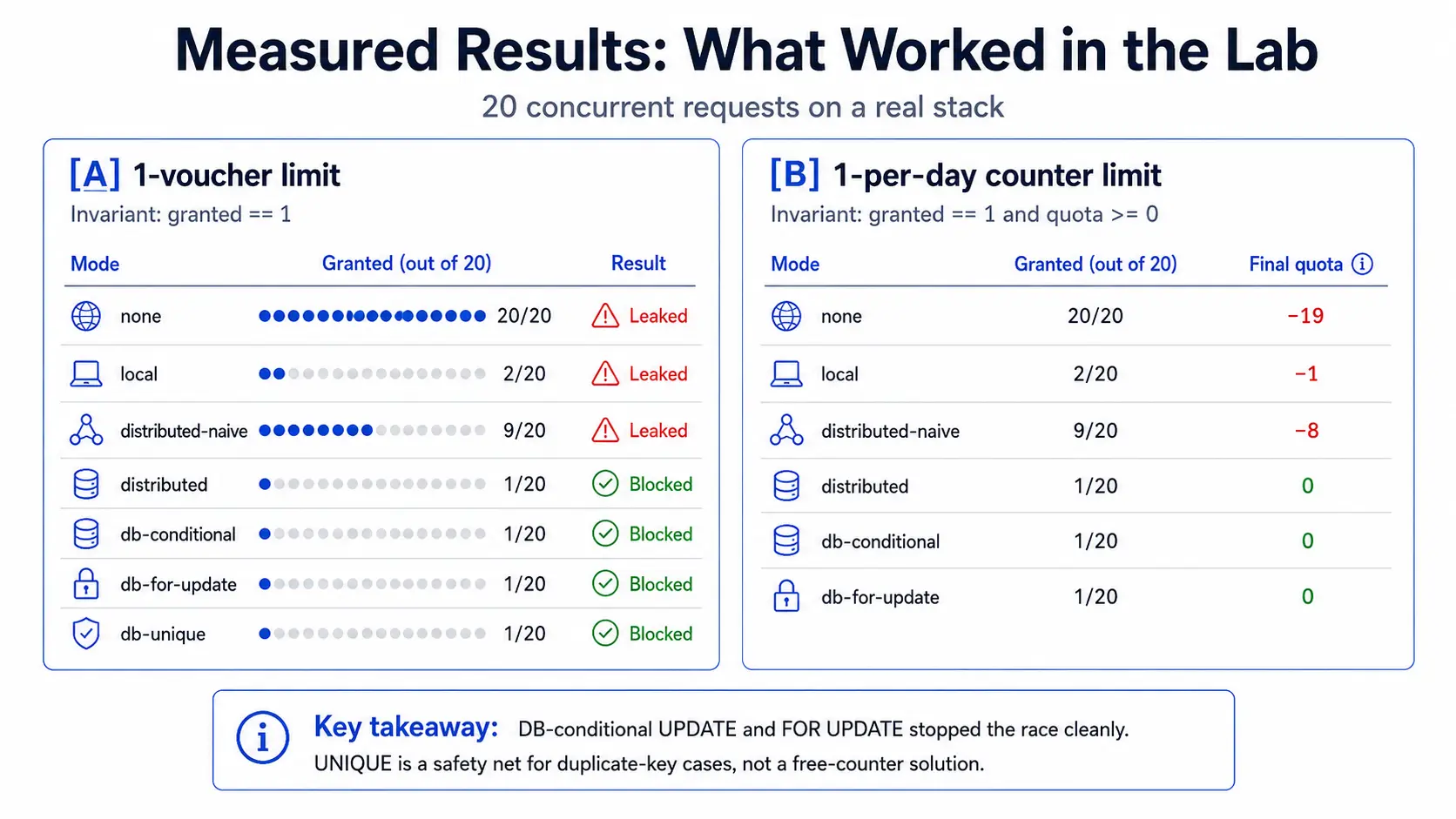
Measured on a real stack. DB-conditional UPDATE and FOR UPDATE stop the race cleanly; UNIQUE is a safety net for duplicate-key cases, not a free-counter solution.
[A] 1-voucher (opportunity) limit — invariant: granted == 1
| Mode | HTTP/1.1 last-byte | HTTP/2 single-packet | Verdict |
|---|---|---|---|
none (no lock, production code) | 16/20 | 20/20 | ⚠ race |
local (JVM lock) | 2/20 | 2/20 | ⚠ leaks by instance count |
distributed-naive (non-atomic lock) | 20/20 | 9/20 | ⚠ still leaks |
distributed (Redisson RLock) | 1/20 | 1/20 | ✅ blocked |
db-conditional (conditional UPDATE) | 1/20 | 1/20 | ✅ blocked |
db-for-update (SELECT … FOR UPDATE) | 1/20 | 1/20 | ✅ blocked |
db-unique (UNIQUE safety net) | 1/20 | 1/20 | ✅ duplicate blocked |
[B] 1-per-day counter limit — invariant: granted == 1 AND quota >= 0 (HTTP/2)
| Mode | Granted | Final quota | Verdict |
|---|---|---|---|
none | 20/20 | -19 | ⚠ counter underflow |
local | 2/20 | -1 | ⚠ leaks |
distributed-naive | 9/20 | -8 | ⚠ leaks |
distributed | 1/20 | 0 | ✅ |
db-conditional | 1/20 | 0 | ✅ |
db-for-update | 1/20 | 0 | ✅ |
db-unique is excluded from [B]: UNIQUE(member, voucher) only blocks “consuming the same voucher twice”; it
cannot cap a free counter (N-per-day). That is the key limit of UNIQUE.
Decisive detail: with db-conditional, out of 20 requests exactly one returned SUCCESS, and the other 19
were cleanly rejected (HTTP 200, not 500) — the conditional UPDATE’s affected=0 → domain exception →
transaction rollback → failure-response conversion, observed per response.
The JVM-local lock leaking exactly by the instance count (2/20 with two WAS) is the empirical proof that
synchronized/ReentrantLock cannot protect a limit across instances. The non-atomic Redis lock leaking
9–20/20 is the proof that a lock which is not atomically acquired buys you nothing under a synchronized
burst.
3. Is the priority order sound? And can conditional UPDATE be the default?
The proposed order — conditional UPDATE → UNIQUE → FOR UPDATE → Redis lock → (supplement) rate limit /
concurrency guard — is broadly sound, but use it as a decision tree keyed on the shape of the
invariant, not a fixed ladder.
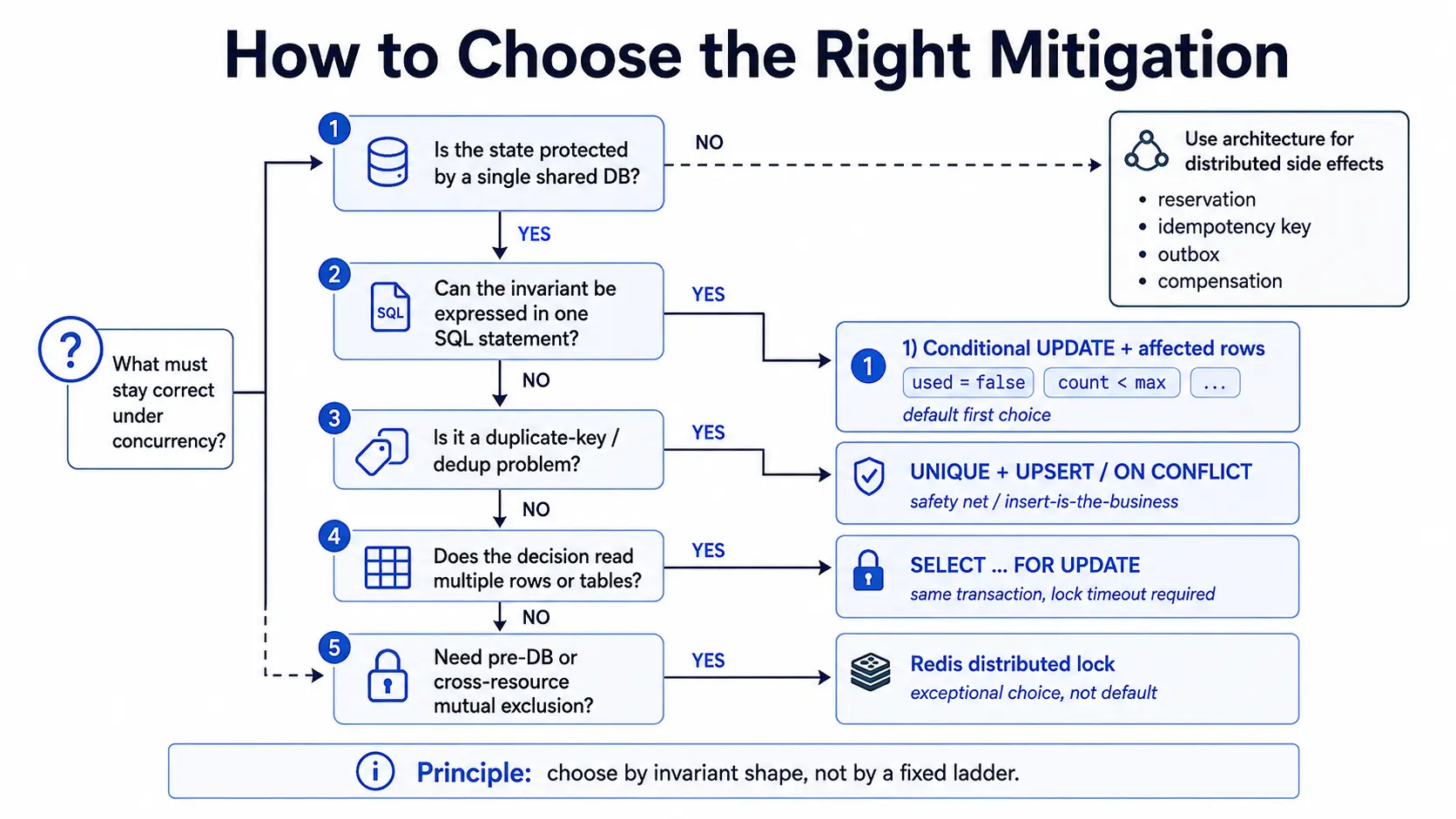
Choose by invariant shape, not by a fixed ladder: single-DB + expressible in one statement → conditional UPDATE; duplicate-key → UNIQUE/UPSERT; multi-row decision → FOR UPDATE; cross-resource mutual exclusion → distributed lock; side effects outside the DB → architecture.
Yes — recommend conditional UPDATE + affected rows as the default first line of defense. But ship it
with four preconditions, not as “just add a WHERE”:
- The CHECK must be expressible as the UPDATE’s WHERE clause —
count < max,used = false,status = 'ISSUED'. - Decide the winner in code via affected rows —
affected == 1→ I won;affected == 0→ someone else already took it / limit exceeded → reject. Skip this and the whole thing is meaningless. - Put side effects that must be atomic with it in the same transaction; keep non-DB side effects out (section 4).
- When reserving multiple resources, guarantee rollback on failure — throw the later-stage failure out of the transactional method so the whole thing rolls back.
Two clarifications the priority list should nail down:
- UNIQUE only covers “duplicate-key” invariants (same voucher / coupon / one entry per event). It cannot cap a free counter (5-per-day) — the lab’s [B] shows this. UNIQUE does not replace conditional UPDATE; it is the last line that stops an invalid state from being persisted.
- A Redis lock is mutual exclusion, not transactional atomicity (Kleppmann, How to do distributed locking). Even holding the lock, a mid-section crash can leave a partial commit. Atomicity is still the DB transaction’s job.
4. Why conditional UPDATE works (an atomic decision in the DB)
Only one request can change the row, because the UPDATE itself re-checks the condition.
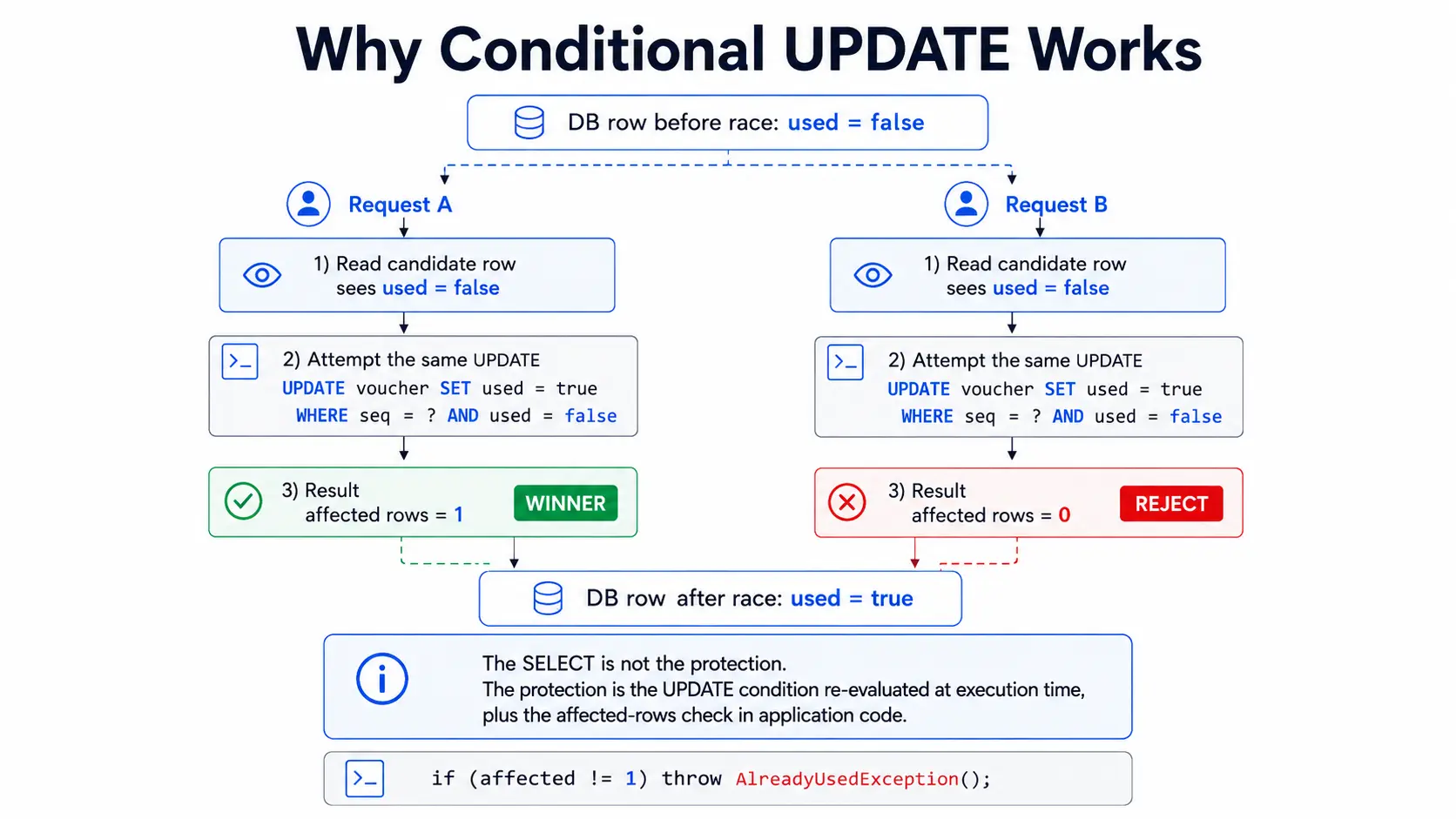
The SELECT is not the protection. The protection is the UPDATE condition, re-evaluated at execution time, plus the affected-rows check in the application. Even with a deliberate 50ms delay, only one request wins.
Why is it safe even though a SELECT → judge → conditional UPDATE still has a SELECT? Under READ COMMITTED
(the PG/MySQL default), the UPDATE re-reads the latest committed row at execution time and re-evaluates the
WHERE. So the defense is the UPDATE’s WHERE + the affected-rows check — not the SELECT. The lab deliberately
reads the candidate without FOR UPDATE and injects a 50ms race window, yet exactly one request wins.
The actual vulnerable code and its fix, side by side:
// AS-IS (vulnerable): CHECK and USE are separated → all see the same stale state and pass
Long seq = jdbc.query("SELECT seq FROM voucher WHERE member_id=? AND used=false ORDER BY seq LIMIT 1", ...);
jdbc.update("UPDATE voucher SET used=true WHERE seq=?", seq);          // no condition → consumed N times

// TO-BE (conditional UPDATE): condition-check + state-change in one statement, decided by affected rows
int affected = jdbc.update(
    "UPDATE voucher SET used=true, used_at=now() WHERE seq=? AND used=false", seq);
if (affected != 1) throw new AlreadyUsedException();                    // only the winner proceeds
For a free counter, the same idea:
int affected = jdbc.update(
    "UPDATE user_daily_counter SET count = count + 1 " +
    "WHERE member_id=? AND business_date=? AND count < ?", memberId, today, maxCount);
if (affected != 1) throw new LimitExceededException();
5. Where conditional UPDATE does not fit — and what to use instead
- Aggregate limits spanning multiple rows (cart total, group-account sum) → a counter/aggregate row, or
FOR UPDATEon the related rows. - CHECK target ≠ UPDATE target (condition on table A, change on table B) → transaction +
FOR UPDATE, or a counter. - Free counter via UNIQUE → use the counter-row conditional UPDATE instead.
- The insert itself is the business (dedup) → UNIQUE + UPSERT /
ON CONFLICT, not conditional UPDATE. - A side effect outside the DB must be atomic with it → section 6.
- Counter-reset boundary (day rollover) where “today’s counter” row does not exist yet → UNIQUE
(member, business_date)+ UPSERT to create the 0-row atomically, then the conditional UPDATE.
SELECT … FOR UPDATE: common traps
FOR UPDATE is powerful but easy to misuse:
- External calls / slow work inside the transaction → holds locks/connections for the whole network round-trip → connection-pool exhaustion. Keep external calls outside.
- No lock-wait bound → set
lock_timeout(PG) /innodb_lock_wait_timeout(MySQL). (The lab usesSET LOCAL lock_timeout='10s'.) - Inconsistent lock ordering → deadlock → always lock in the same order; the lab locks a single per-member anchor row.
- You cannot lock a row that does not exist → an insert race needs UNIQUE + UPSERT.
- Unindexed conditions → wide-range or gap locks; the lab adds a partial index for candidate selection.
- ORM pitfalls → reading without
@Locktakes no lock; watch lazy loading / 2nd-level cache. SKIP LOCKEDmisuse → it silently skips rows; fine for “pick distinct items off a queue”, wrong for “mutual exclusion on one resource”.
6. When an external API is involved (point grant / payment / coupon cancel)
Core principle: inside the DB transaction, only atomically reserve the right; call the external API outside the transaction, idempotently. Putting the external call in the transaction holds locks for the network round-trip and is not atomic with the DB commit anyway (only one of the two can succeed).
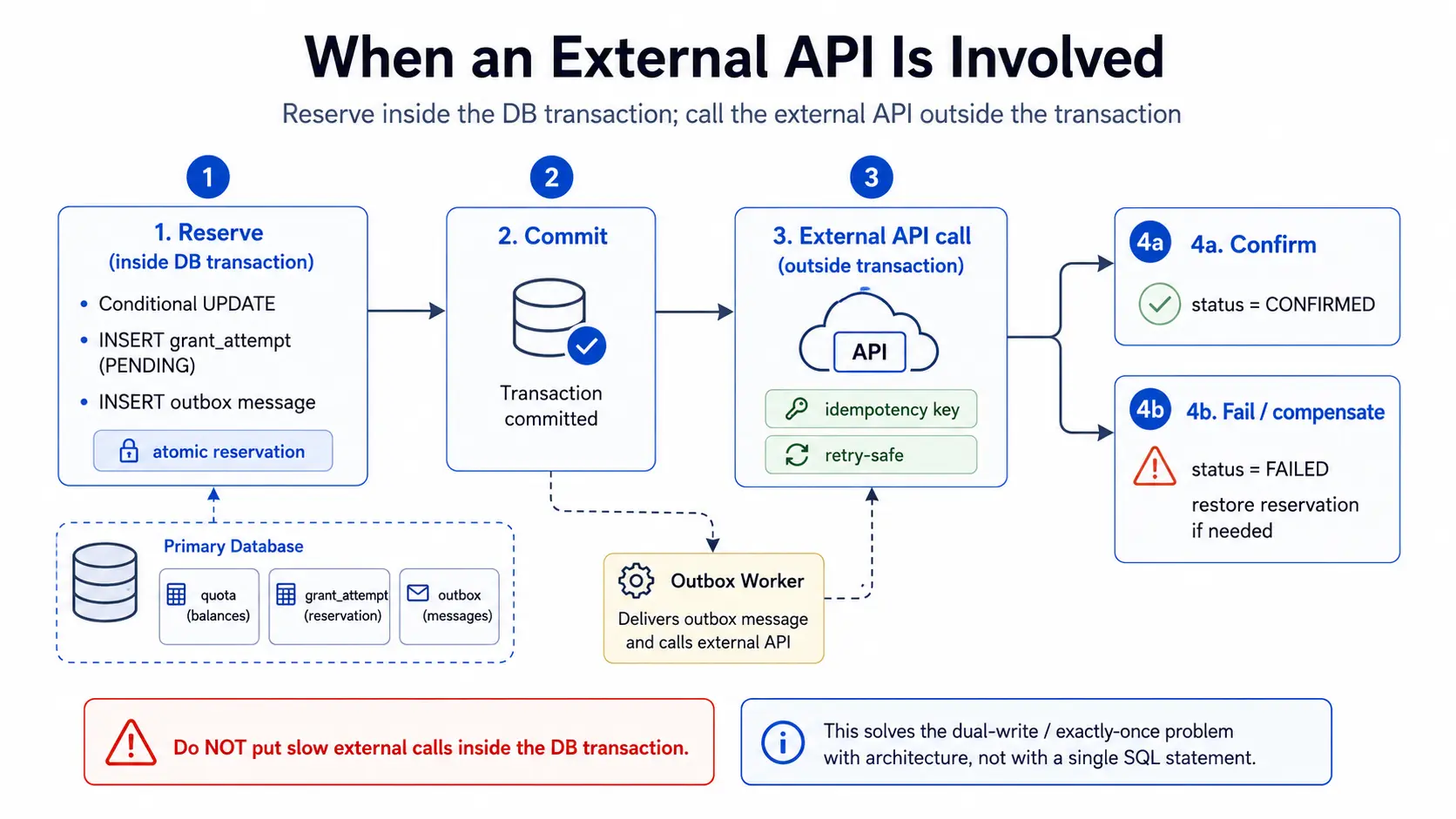
Reserve → Commit → External call → Confirm. Never put a slow external call inside the DB transaction. Idempotency key + Outbox + compensation give exactly-once effect through architecture, not one SQL statement.
1) [TX begin]
   Reserve the limit/opportunity with a conditional UPDATE  (must be affected==1 to proceed)
   INSERT a grant-attempt record (status=PENDING, idempotency_key=UUID)
   [TX commit]             ← this far is the atomic reservation. If it fails, nothing happened.

2) [outside TX] Call the external API (carry idempotency_key → retries do not double-spend)

3) Transition state (conditional UPDATE):
   success → UPDATE ... SET status=CONFIRMED WHERE id=? AND status=PENDING
   failure → UPDATE ... SET status=FAILED    WHERE id=? AND status=PENDING  + compensate (restore counter)
- Idempotency key — the fundamental exactly-once device. If the external side doesn’t support it, filter duplicates via a UNIQUE(idempotency_key) on our “grant attempt” table.
- Outbox pattern — write the reservation and the “message to send” in the same transaction; a worker delivers it. Resolves the dual-write problem.
- State machine + compensation —
PENDING → CONFIRMED/FAILED; if it cannot be confirmed, restore the reservation (saga). - Reconciliation — periodically reconcile with the external system; the final safety net.
Duplicate coupon cancellation is a special case: cancellation is a state-transition CAS
(UPDATE coupon SET status='CANCELED' WHERE coupon_id=:id AND status='ISSUED'). Only the affected==1
request actually cancels and calls the refund API (with an idempotency key). Same pattern as
db-conditional.
7. Redis lock — needed vs. overkill; and rate limit vs. concurrency guard
Needed: the state that must change atomically spans multiple resources / DBs / cache / external systems and cannot be wrapped by a single DB transaction; or you need per-member serialization in a pre-DB-write stage; or you’re reducing DB row-lock contention on a very hot key at the front (integrity still lives in the DB).
Overkill: a single-DB single-row/counter problem where a conditional UPDATE already suffices; treating a
Redis lock as an integrity guarantee; non-atomic acquisition (the lab’s distributed-naive, leaking
9–20/20). If you use it, always do atomic acquisition (SET key <token> NX PX <ttl>) + owner-token release +
TTL + an explicit failure policy.
For rate limit vs. concurrency guard — neither is the root fix:
| Control | Layer | Purpose | Integrity tool? |
|---|---|---|---|
| Rate limit (10 req/s) | edge / gateway | abuse/DoS/cost protection | ❌ — a race happens with 2–3 concurrent |
| Concurrency guard (same user + same object → 1 at a time) | application | dampen race amplification, reduce backend load | △ supplement only |
| Atomic processing (conditional UPDATE) | DB / transaction | guarantees integrity | ✅ root |
Placement: edge = rate limit (policy/cost) · app = DB atomicity (root) · optional app-front concurrency guard (buffer). The order must not invert.
8. Turn the recurring bug into a standard, not a pile of patches
If the same check → act race recurs across services, eliminate the pattern, not each instance:
- Secure Coding Rule — “For limits / opportunities / counters / state transitions, do not split into
read-then-judge-then-change; process CHECK and USE as one atomic DB operation, and decide success by
affected rows (or a UNIQUE violation).” Forbidden:
getCount()/findUnused()→if→insert()/update(). - Shared abstraction — a helper that encapsulates the
affected==1check, so teams don’t reinvent it. - Static-analysis rule (Semgrep) — flag “branch on a SELECT/count result, then insert/update the same entity” in PRs; wire it into CI.
- Schema-design standard — bake UNIQUE constraints (duplicate-key) and counter columns (free-counter) into the schema at design time.
- Concurrency regression tests — fire concurrent requests aligned to one instant (like this lab’s
last-byte / single-packet runners) and assert invariants (
granted==1) in CI. The lab’srun_all.shexits 1 when a mitigation leaks. - Review checklist — CHECK moved into the WHERE? success decided by affected rows? atomic side effects in the same transaction, external calls outside? failure path throws out to roll back? dedup-insert has a UNIQUE?
@Transactional must-dos (frequently botched)
- Throw the rejection out of the transactional method. Catching it inside and returning a normal
response commits the earlier steps (e.g. the counter is decremented but “succeeds”). Throw to roll back;
catch it outside the transaction to convert to a user response. (In the lab,
ClaimService.guarded()catches the domain /DuplicateKeyExceptionoutside the transaction.) - Default rollback applies only to unchecked exceptions (else
@Transactional(rollbackFor=…)). - Beware self-invocation (an internal call bypasses the proxy).
- Never put external API calls inside the transaction.
Minimal-change fixes exist for JPA (@Modifying @Query with an affected-rows return) and MyBatis (mapper
update() returns affected rows) too — full examples are in the repo guide.
9. The final policy statement (security → dev)
[Concurrency Integrity Policy]
- For per-user limits / opportunities / points / state transitions, do not split into read-then-judge-then change — process CHECK and USE as a single atomic DB operation.
- Evaluate a DB conditional UPDATE + affected-rows check first (recommended #1). Decide success by
affected==1; otherwise reject.- Add a UNIQUE constraint as the last safety net for duplicate-key limits. If needed, use
SELECT … FOR UPDATE(lock-wait bound mandatory) or a distributed lock.- For external grant / payment / cancellation, atomically reserve in the DB, then call externally outside the transaction with an idempotency key. Rate limiting is abuse prevention, not an integrity measure.
We do not mandate a specific implementation (e.g. a Redis lock). The requirement is “guarantee atomicity so that limits are not exceeded even under concurrent requests,” and you choose the method from the priority above to fit your service.
References
Race conditions / TOCTOU
- CWE-367 — Time-of-check Time-of-use (TOCTOU) Race Condition. https://cwe.mitre.org/data/definitions/367.html
- CWE-362 — Concurrent Execution using Shared Resource with Improper Synchronization. https://cwe.mitre.org/data/definitions/362.html
- James Kettle — Smashing the State Machine: The True Potential of Web Race Conditions, PortSwigger Research (Black Hat USA / DEF CON 31), 2023. https://portswigger.net/research/smashing-the-state-machine
- James Kettle — Listen to the Whispers: Web Timing Attacks That Actually Work, PortSwigger Research (Black Hat USA / DEF CON 32), 2024. https://portswigger.net/research/listen-to-the-whispers-web-timing-attacks-that-actually-work
- PortSwigger Web Security Academy — Race conditions. https://portswigger.net/web-security/race-conditions
- Mohammad Amin Nasiri — H2SpaceX: HTTP/2 Single Packet Attack (Last Frame Synchronization) library. https://github.com/nxenon/h2spacex (HTTP/3: https://github.com/nxenon/h3spacex)
- Federico Loi, Lorenzo Pisu, Leonardo Regano, Davide Maiorca, Giorgio Giacinto — Race Against Time: Investigating the Factors that Influence Web Race Condition Exploits, Computers & Security 160 (2026) 104740. DOI: https://doi.org/10.1016/j.cose.2025.104740
- Mohammad Amin Nasiri, Efstratios Chatzoglou, Georgios Kambourakis — QUIC-er Races: HTTP/3 Won’t Save You from TOCTOU Vulnerabilities, Int. J. Information Security 25, 83 (2026). DOI: https://doi.org/10.1007/s10207-026-01258-6
DB atomicity & locking
- PostgreSQL — Transaction Isolation (READ COMMITTED). https://www.postgresql.org/docs/current/transaction-iso.html
- PostgreSQL — Explicit Locking (row locks,
FOR UPDATE, deadlocks). https://www.postgresql.org/docs/current/explicit-locking.html - PostgreSQL —
SELECT … FOR UPDATE/SKIP LOCKED. https://www.postgresql.org/docs/current/sql-select.html - PostgreSQL —
INSERT … ON CONFLICT(UPSERT). https://www.postgresql.org/docs/current/sql-insert.html - MySQL — Locking Reads (
SELECT … FOR UPDATE/FOR SHARE). https://dev.mysql.com/doc/refman/8.0/en/innodb-locking-reads.html
Distributed locks
- Redis — Distributed Locks (Redlock). https://redis.io/docs/latest/develop/use/patterns/distributed-locks/
- Martin Kleppmann — How to do distributed locking. https://martin.kleppmann.com/2016/02/08/how-to-do-distributed-locking.html
- Redisson — Distributed locks and synchronizers. https://github.com/redisson/redisson/wiki/8.-Distributed-locks-and-synchronizers
Reliable external side effects
- Chris Richardson — Transactional Outbox pattern. https://microservices.io/patterns/data/transactional-outbox.html
- Chris Richardson — Saga pattern. https://microservices.io/patterns/data/saga.html
- Chris Richardson — Idempotent Consumer pattern. https://microservices.io/patterns/communication-style/idempotent-consumer.html
- Stripe API — Idempotent requests. https://docs.stripe.com/api/idempotent_requests
Framework / client implementation
- Spring Framework — Declarative transaction management (
@Transactional). https://docs.spring.io/spring-framework/reference/data-access/transaction/declarative/annotations.html - Spring Framework 6.1 Release Notes — RestClient/RestTemplate stop buffering request bodies (to reduce memory usage); some content types are sent without
Content-Length. https://github.com/spring-projects/spring-framework/wiki/Spring-Framework-6.1-Release-Notes - Spring Framework Issue #30557 — Remove buffering in ClientHttpRequestFactory implementations. https://github.com/spring-projects/spring-framework/issues/30557
Lab
- Repository & reproducible lab (this article’s code and measurements). https://github.com/windshock/race-condition-lab
- Transfer/synchronization technique borrowed from waf-ips-ids-retest TC-24. https://github.com/windshock/waf-ips-ids-retest/