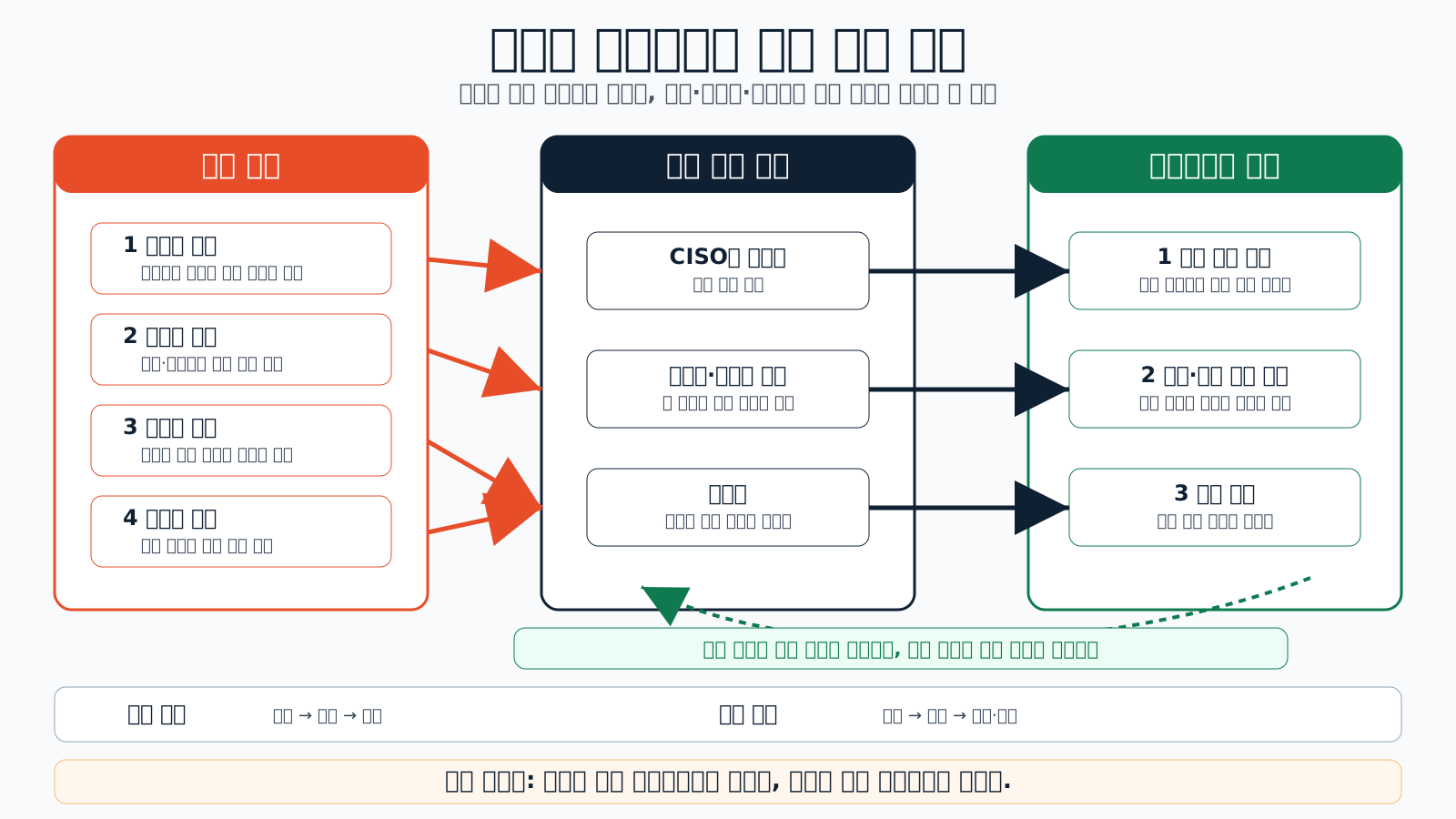
This is Part 4 of the AI-era Korean security governance series. Previous parts covered the problem, the equilibrium structure, and adaptive-capability metrics. This part addresses how, even if policy agencies do not move first, the market can drag governance forward.
- Part 1: Korean security governance is accelerating in the wrong direction in the AI era
- Part 2: Why Korean security governance does not change
- Part 3: How do we measure adaptive capability?
- Part 4: Can the market move governance?
- Part 5: The Real Battleground of National AI Strategy Is Not Just GPU Count
Policy is not the only thing that creates change
The earlier posts in the series converged on the same question. Why is Korean security governance stuck, and what can shake the equilibrium?
Many discussions then turn automatically to policymakers. But that may be too narrow a view. Change is not made only by policy agencies. In some cases market actors create stronger change.
Why can the market be stronger?
Governance actors mainly play the authority game. Who holds the initiative, who concedes territory, who bears accountability — that is the core.
Market actors play the cost game.
- After an incident, premiums go up.
- Customers raise their requirements.
- Investors discount operational risk.
- Supply-chain assessments insert new criteria.
Actors strong in the authority game are weak in the cost game. So change sometimes comes in faster through a price tag than through an ought.
External actor 1: insurance
Once cyber insurance matures, the important question shifts.
- Does this firm hold ISMS-P?
- — to —
- How fast does this firm respond to a new risk?
Insurers want signals that reduce incident probability and loss size. Once adaptive-capability metrics enter insurance models, firms can no longer claim a certificate alone is enough.
External actor 2: customers and supply chain
Many firms already impose security requirements on suppliers. Today, certificate submission may be the center; over time the question can shift.
- What was your recent response time for high-severity vulnerabilities?
- Do you have a re-search system?
- Do you have an emergency temporary-mitigation procedure?
- If you use AI-based analysis, do you have a verification procedure?
The moment these questions enter customer procurement documents, adaptive capability stops being an abstract concept and becomes a contractual requirement.
External actor 3: rating services and the grade market
Internationally, security rating markets like BitSight and SecurityScorecard already exist. The core of this model is simple: compress a firm’s security posture into a single signal and supply it to the external market.
A similar current is plausible in Korea. Especially as AI-based analysis tools improve, a new evaluation model that combines public assets, exposed services, vulnerable patterns, and response speed can emerge.
Why does this matter? Because the market can consume signals first, even without government endorsement.
But there is no need to force a public external rating from the start. Externally scoring firms carries significant legal and reputational risk. The realistic starting point is a non-public adaptive-capability assessment tool that helps firms measure their own MTTA, MTTP, MTRS internally.
External actor 4: security SaaS and data standards
Platforms often set standards before policy does. When a security SaaS captures enough customers, the dashboard and criteria it provides effectively act as an industry operational standard.
- Which alerts are treated as important?
- What time is considered fast?
- Which verification procedures count as the minimum?
Once these get baked into software, the standard operates inside the product before any document arrives.
Can emerging actors be the change driver?
One caveat. Within governance, an actor whose authority is newly growing — newly establishing or expanding its territory — can also be a change driver. But having momentum does not guarantee the direction we want. Emerging actors usually move toward adding new guardrails because that is the fastest path to territorial expansion. Adding more guardrails makes governance more complex but does not increase adaptive capability.
That is why market actors can be a stronger lever. Insurance, customers, supply chains, and investors move toward pricing existing behavior, not adding new items. When that price weakens the indemnity effect of standards compliance and offsets the individual loss of autonomous judgment, the incentive alignment needed to move the equilibrium finally begins.
So is government unnecessary?
No. Policy still matters. But the order does not always have to be “policy → market.” Sometimes it is the reverse.
- Researchers and practitioners create the language.
- The field creates metrics and templates.
- The market prices those metrics.
- Policy agencies follow and codify.
In other words, policy is not the only starting point. It can be the pursuer of change that has already begun.
The cold force of capitalism
Why does this matter? Actors inside the governance structure do not move much on good writing and good oughts alone. But add a cost, and they behave differently.
- Higher premiums move the CFO.
- Customer demands move the sales organization.
- Supply-chain criteria move partners.
- Investor questions move executives.
So the strongest message for breaking equilibrium is often not “this is right” but “not doing this is expensive.”
A realistic place to start
So where can we start in practice?
1. Publish minimum metrics
Propose minimum metrics like MTTA, MTTP, MTRS first, and share industry averages or example templates.
2. Pilot supply-chain requirements
If one or two private firms begin including adaptive-capability questions in supplier assessments, a small change can spread.
3. Connect to insurance, investment, and audit
Once these metrics begin to connect with external stakeholders rather than serving as internal management only, governance starts taking pressure from the market, not from documents.
4. Policy absorbs later
Policy agencies can fold the current into the institution later. By then, change is no longer an abstract claim — it is a market-validated signal.
Series conclusion so far
The series so far has stacked four claims step by step.
- Korean security governance is accelerating in the wrong direction in the AI era.
- The cause is closer to multi-actor equilibrium than to incompetence.
- Therefore we need metrics and templates that measure adaptive capability.
- And that change can be created by market actors, not only policy agencies.
The core, in the end, is one.
Change does not arrive on oughts alone. It comes in on cost, signal, and market.
So making the language of adaptive capability is not a mere policy debate. It is also defining the market of the future, early.
In The Real Battleground of National AI Strategy Is Not Just GPU Count, the discussion extends from organizational and market governance to national AI strategy and control plane sovereignty.